FlemingClans.com

"Scotland's Fleming Clan: a Genealogical History" - coming in 2027!
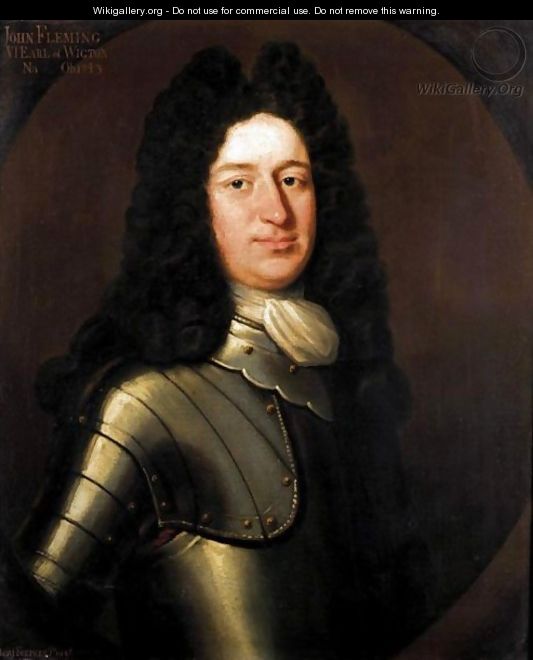 22nd chief - John Fleming, 6th Earl of Wigtown and 11th Lord Fleming
(c1668 - 1744)
Basic information about this person: \click here\
John, 6th Earl of Wigtown, inherited the earldom as a boy, was educated in Catholic seminaries in France, and spent much of his life under suspicion as a Jacobite. He voted against the Union of 1707 and was imprisoned in Edinburgh Castle during the 1715 rising. His only surviving child was a daughter.
A boy earl
John was born around 1668, the elder son of William Fleming, 5th Earl of Wigtown, and Henrietta Seton. He succeeded his father on 8 April 1681 when he was about thirteen, and was placed under tutors. In 1684 King Charles II appointed James Drummond, 4th Earl of Perth, the Chancellor of Scotland and a kinsman, as his tutor. Perth became a Catholic, and in 1687 he sent John to the Scots College in Paris.
Exile in France
When James VII was overthrown in the Revolution of 1688, John remained loyal to him and lived among the exiled court at the Château de Saint-Germain-en-Laye. He and his brother Charles also spent time at the Scots College at Douai. In 1690 their mother petitioned the Scottish Parliament against the Earl of Perth for converting her sons to Catholicism and sending them to foreign seminaries, producing a letter in which John complained that the “papists” intended to make Jesuits of the brothers. Parliament even considered releasing Perth from prison if he would secure the young men’s return. In 1691 John wrote that he did not intend to come home until he had £300 sterling to complete his studies.
Opposing the Union
By 1695 John had returned to Scotland. He served as a commissioner of supply for Dunbartonshire and Stirlingshire, and sat in the Parliaments of 1703 to 1707. He joined the Earl of Mar’s protest in 1703 and supported the Duke of Atholl’s motions protesting against the English Alien Act in 1705 and opposing the Treaty of Union in November 1706. In 1705 Parliament granted him weekly markets at Denny and fairs at Denny and Cumbernauld.
The Fifteen
When the Earl of Mar raised the Jacobite standard in 1715, the government took no chances with known sympathisers. On 20 August 1715 John was committed as a prisoner to Edinburgh Castle, and he was not released until June 1716, after the rising had been defeated.
Later years
In his later years John was involved in an almost constant stream of lawsuits in the Court of Session, against the town of Kirkintilloch, the residents of Biggar over their rights on the common, and many others. In 1736 he became King’s Chamberlain in Fife. He presented ministers to the churches of Broughton and Drumelzier, of which he was patron.
With no son to succeed him, John took steps to protect his estates. In 1741 he made a new entail to prevent his title being merged with another, and in 1742 he placed all his property in trust. He died in Edinburgh on 10 February 1744 and was buried at Biggar.
Family and legacy
John married three times: first Margaret Lindsay, daughter of the 3rd Earl of Balcarres, whose daughter Margaret died young; secondly Mary Keith, daughter of the 8th Earl Marischal, mother of his heiress Clementina; and thirdly Euphame Lockhart, daughter of George Lockhart of Carnwath, the Jacobite author of the Memoirs of Scotland. His nickname, “the Pliant”, reflects his ability to survive dangerous times. The earldom passed to his brother Charles.